
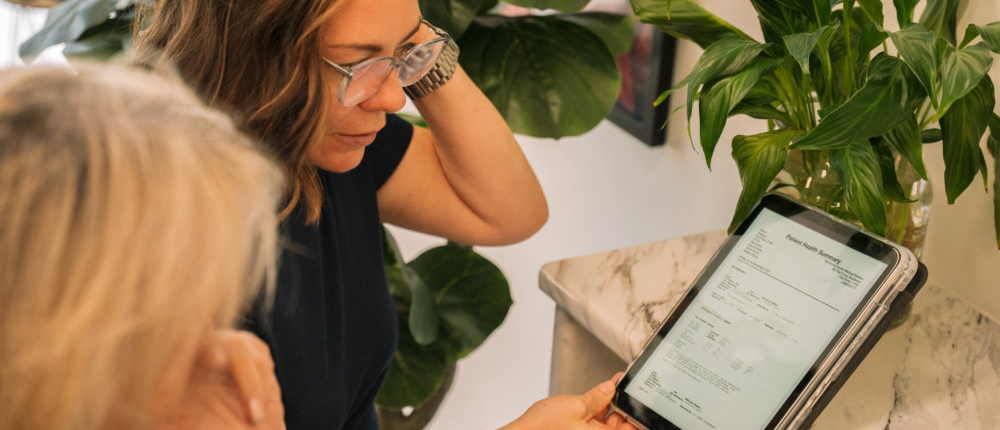
Why Does Hair Become Drier and More Brittle During Menopause?
If your hair used to feel soft, flexible and reasonably forgiving, only to become drier, rougher or more fragile in your 40s or 50s, it can be surprisingly difficult to work out what has changed.
You may find that the ends feel crunchy even after conditioning. Your hair may tangle more easily, snap when you brush it or seem unable to tolerate the same amount of colouring and heat styling it once did. Products that used to leave it smooth may suddenly seem to do very little.
It is easy to put all of this down to menopause. In reality, midlife hair is usually more complicated than that.
Perimenopause and menopause happen alongside major hormonal changes, and reputable health organisations recognise that women can experience changes in their hair during this stage of life. Hair thinning is particularly well documented. At the same time, dryness and brittleness can also be influenced by greying, chemical processing, heat styling, environmental exposure, changes in density and the cumulative effect of how the hair has been treated over many years.
If your hair simply feels different rather than specifically dry or fragile, start with our guide to menopause and changing hair texture. Here, we are concentrating on a more specific problem: hair that feels dry, brittle or increasingly prone to breaking.
Does menopause actually make your hair dry?
There is no useful one-size-fits-all answer.
Menopause involves falling and fluctuating hormone levels, and these changes can affect hair growth and the characteristics of the hair you see on your scalp. The American Academy of Dermatology notes that menopause can bring noticeable changes to the hair and skin, while Healthdirect lists thinning hair among the body changes women may experience after menopause.
But that does not mean every woman develops dry hair because her oestrogen has dropped, or that hormones are the only explanation when hair becomes rough or brittle.
By this stage of life, your hair may also have been coloured, highlighted, blow-dried, straightened and exposed to sun, swimming and everyday wear for decades. You may have more grey hair than before. Your density may have changed. You may be using the same products and heat settings you used when the hair itself behaved very differently.
That is why the better question is not simply, “Is menopause making my hair dry?” It is:
What is making my hair feel dry now – and what can I change without causing even more damage?
Dry hair, damaged hair and brittle hair are not exactly the same thing
These terms are often used interchangeably, but they describe slightly different problems.
Hair can feel dry without being badly damaged. Damaged hair can also feel dry, but damage usually means the structure of the hair shaft has been compromised. Brittle hair is hair that has lost enough flexibility that it is more likely to snap or break under stress.
Working out which problem you have matters because adding more conditioner to genuinely damaged, breaking hair may improve the feel temporarily without removing the cause.
| What you notice | What it may suggest | What to consider |
|---|---|---|
| Hair feels rough or thirsty but is not snapping | Dryness or a product/routine mismatch | Review cleansing, conditioning, heat and styling products |
| Ends look frayed or split | Wear, weathering or structural damage | A trim may be more effective than repeatedly coating damaged ends |
| Short pieces are appearing through the lengths | Possible breakage | Look at heat, chemical services, brushing and mechanical stress |
| Hair stretches excessively when wet or feels weak | Possible structural damage | Reduce further chemical and heat stress and have the condition assessed |
| Hair feels stiff, coarse and easily tangled | Dryness, grey texture, build-up or damage may all contribute | Do not assume one heavy mask will solve every cause |
| Your ponytail is smaller but strands are not visibly snapping | Possible density loss rather than breakage | Consider whether this is a thinning issue rather than a condition issue |
Why might midlife hair become more brittle?
Brittleness usually develops when hair becomes less able to cope with ordinary physical and chemical stress.
Healthy hair still experiences wear every day. It gets washed, dried, brushed, tied back, slept on and exposed to weather. Colouring, lightening and heat styling add additional stress. Usually, the hair can tolerate a certain amount of that treatment without immediately breaking.
The problem comes when the amount of stress starts to exceed what the hair can comfortably handle.
That threshold may change over time.
A colouring routine that your hair seemed to tolerate easily in your 30s may leave it feeling progressively drier in your 50s. Repeated straightening may become much more noticeable. Bleached ends that have been processed several times may no longer have the flexibility they once did.
This does not mean you have to stop colouring or styling your hair. It means the condition of the hair should be part of the decision about what you do next.
Why does coloured hair often feel drier as you get older?
Colouring is one of the biggest areas where midlife hair routines sometimes need to evolve.
You may have more grey to manage, which can lead to more frequent appointments or more frequent root colouring. At the same time, you may still have older colour or lightener sitting through the lengths.
The result can be very different hair from root to tip.
Your newest growth may be comparatively strong. The mid-lengths may have been coloured several times. The ends may have been through years of colouring, heat styling and environmental exposure.
If every part of that hair is treated as though it has the same history and condition, the oldest sections can become progressively more fragile.
This is one reason a colour plan should not simply be about covering grey as quickly as possible. It should also consider what the hair can tolerate and how much ongoing maintenance you actually want.
If grey coverage itself is becoming exhausting, grey blending may be worth discussing. It will not be the right choice for everyone, but for some women a softer approach to grey can reduce the pressure to maintain a very solid colour result.
You can also read our guide to grey blending vs grey coverage if you are weighing up the differences.
Is dry hair the same as hair that needs protein?
No – and this is where home haircare can become unnecessarily complicated.
Once hair starts feeling dry or weak, it is common to start adding masks, oils, protein treatments, bond products and leave-in conditioners all at once. That can make it very difficult to tell what the hair actually needs.
Hair that feels dry may benefit from better conditioning and gentler handling. Hair that has been chemically compromised may need a different strategy. Hair that is simply overloaded with products may feel dull, heavy or rough even though adding yet another treatment is not the solution.
There is also a limit to what any product can do.
A good treatment can improve softness, manageability and the way damaged hair feels. It can help reduce further stress and make styling easier. But no salon mask can permanently rebuild a split end into untouched hair.
If the end of a strand is badly damaged, sometimes the most effective treatment is a pair of scissors.
Can damaged hair actually be repaired?
This depends on what you mean by “repaired”.
Hair products and professional treatments can improve the condition, feel and manageability of compromised hair. Modern bond-building and conditioning treatments can also help support hair that has been chemically stressed.
What they cannot do is turn heavily weathered hair back into completely virgin hair.
If you are dealing with severe splitting, repeated snapping or ends that remain thin and transparent regardless of how many treatments you use, holding onto every centimetre of length may actually make the hair look worse.
We explain this distinction in much more detail in Can Damaged Hair Be Repaired or Does It Need to Be Cut Off?.
One useful reality check
If you have spent months trying to “repair” the same dry ends and they still split, tangle and look wispy, the problem may not be that you have failed to find the right product.
You may simply be trying to preserve hair that has reached the end of what it can comfortably tolerate.
How can you tell whether your hair is breaking?
Hair breakage and hair shedding are often confused.
When a hair sheds naturally from the scalp, the full strand comes away. When hair breaks, the strand snaps somewhere along its length.
Breakage can show up as short pieces around the hairline, uneven lengths through the hairstyle, ends that become progressively thinner, or lots of small pieces appearing during brushing and styling.
Some breakage is obvious. Other times women simply notice that their hair “never seems to grow” even though the roots are growing normally. In reality, the ends may be breaking at roughly the same rate the hair is growing from the scalp.
If that sounds familiar, read Why Is My Hair Breaking Off?, where we look specifically at the common causes of breakage.
Could your heat styling be too much for your hair now?
Heat is not automatically the enemy. Plenty of women blow-dry and style their hair regularly without destroying it.
Problems are more likely when very high heat, repeated passes and frequent styling are combined with hair that is already chemically processed or fragile.
If your hair has become drier or more brittle, the way you use your tools may need adjusting.
- Avoid automatically using the highest temperature available.
- Make sure hair is properly dry before using tools designed for dry hair.
- Use heat protection consistently.
- Try not to make repeated passes over the same section simply because one pass did not create a perfect result.
- Be particularly cautious around fragile hairlines and lightened ends.
You may also find that a haircut which works better with your natural movement reduces how much heat styling you need in the first place.
Can brushing cause brittle hair to break?
Yes, particularly if the hair is already vulnerable.
Hair does not usually snap because of one dramatic brushing session. More often it is the cumulative effect of repeated pulling, rough detangling and tension on hair that is already dry or compromised.
Healthdirect recommends gentle haircare techniques such as using wide-tooth combs and blotting rather than rubbing the hair dry when reducing breakage is a concern. :contentReference[oaicite:1]{index=1}
If your hair tangles easily, start at the ends and work upward rather than dragging a brush from the roots through every knot. Be especially patient with wet or chemically processed hair, and avoid treating stubborn tangles as something to simply force through.
Does menopause mean you should stop going blonde?
No.
There is no age at which you suddenly become too old for blonde hair, highlights, balayage or any other colour you enjoy.
The more useful question is whether your current colour plan suits the condition of your hair.
If your hair is strong and healthy, lightening may still work beautifully. If your ends are becoming fragile, constantly pushing them lighter may not be the best trade-off. Sometimes modifying the placement, brightness, frequency or amount of lightening can preserve the look you love without asking quite so much of the hair.
That is a very different conversation from telling a woman she should go darker because she is older.
Colour should still be about what suits you, what you enjoy and what your hair can realistically maintain. We look more broadly at that decision in Should You Change Your Hair Colour as You Get Older? What Actually Works.
What can a salon treatment realistically do?
A professional treatment can be very useful when the goal is to improve moisture, softness, manageability and the overall feel of the hair.
At The Cutting Room, the right hair treatment depends on what the hair actually needs. That is more useful than choosing a treatment simply because the label says “repair”, “moisture” or “anti-ageing”.
A treatment can also be part of a bigger strategy. If your hair is being coloured, we can look at whether the current service is placing unnecessary stress on already fragile sections. If the ends are damaged, we can discuss whether a trim will improve the overall shape and condition. If your home routine is contributing to the problem, simplifying it may be more helpful than sending you home with five additional products.
The goal is not to make your bathroom shelf bigger. It is to make your hair easier to live with.
Do this – rather than trying to fix everything at once
| If your hair is… | Try this first | Avoid automatically doing this |
|---|---|---|
| Dry and rough | Review conditioning, cleansing and heat exposure | Adding several heavy products at once |
| Breaking through the lengths | Reduce chemical, heat and mechanical stress | Trying to disguise every broken piece with more heat |
| Split at the ends | Discuss whether those ends need trimming | Expecting a serum to permanently repair the split |
| Fine and easily weighed down | Use lighter products suited to the current texture | Assuming “dry” automatically means richer and heavier |
| Dry after repeated lightening | Review the colour plan as well as the treatment plan | Continuing the same processing and compensating with masks |
| Suddenly much thinner overall | Consider whether density loss needs assessment | Assuming it is simply dryness or damage |
What should you change at home?
You do not necessarily need an elaborate menopause-specific hair routine.
Start with a few basics.
Use a shampoo and conditioner that suit your current hair
If the products you have used for years have stopped working, reconsider them. That does not mean automatically buying the richest products you can find. Fine hair that is slightly dry has very different needs from thick, coarse, heavily lightened hair.
Be gentler when the hair is wet
Wet hair can be more vulnerable to stretching and mechanical stress. Avoid aggressive towel rubbing and impatient detangling.
Review your heat
If the hair is becoming fragile, lowering the temperature or reducing the number of passes with hot tools may matter more than buying another “repair” product.
Pay attention to the ends
The ends are the oldest part of your hair. If they are constantly splitting and tangling, they may be telling you that they have had enough.
Change one thing at a time
If you replace your shampoo, conditioner, mask, leave-in product and styling cream on the same day, you will have no idea which change helped. Give yourself a chance to understand your hair rather than turning the bathroom into a laboratory.
When does dry or brittle hair need more than a salon solution?
Dryness and breakage are often haircare and condition issues, but not every change belongs in the salon.
If your concern is accompanied by noticeably increased shedding, a widening part, progressive loss of density or scalp symptoms, it is important not to assume that the hair is simply becoming “dry because of menopause”.
Female pattern hair loss becomes more common after menopause, and Healthdirect notes that almost half of females show signs of hair loss by age 50. Hair loss can have different causes, so meaningful changes in density deserve proper assessment rather than guesswork. :contentReference[oaicite:2]{index=2}
The Hair & Scalp Analysis at Tricho Health Clinic is a more appropriate starting point when your concern includes unexplained shedding, thinning or scalp changes rather than simply the cosmetic condition of the hair.
Before your next salon appointment, look for these clues
You do not need to diagnose your own hair. But a little observation can make the consultation much more useful.
- Does the hair feel dry all over or mainly through the ends?
- Are you seeing full hairs shed from the scalp or short pieces breaking?
- Has the problem become worse after colouring or lightening?
- Are particular areas much more fragile than others?
- Has your heat-styling routine changed?
- Are the ends continually splitting despite regular treatments?
- Has the amount of hair changed as well as its condition?
Those details help separate a moisture problem from damage, breakage, a colour issue or a possible density concern.
Your hair may need a different strategy, not more effort
One of the most frustrating things about midlife hair is that doing more does not always produce a better result.
More conditioner will not fix every damaged end. More heat will not necessarily tame hair that is breaking. More colour can create another problem if the existing hair is already fragile. And holding onto length at all costs does not always make hair look longer or healthier.
Sometimes the answer is surprisingly simple: a better-conditioned routine, gentler styling, a slightly different colour plan, a treatment chosen for the actual condition of the hair, or removing ends that are no longer serving the overall shape.
At The Cutting Room, the aim is not to tell you that you need completely different hair because you have reached a particular age. It is to look at the hair you have now and make decisions that help it look and feel its best.
If your hair has become dry, brittle or difficult to manage and you are not sure whether the issue is condition, damage, colour or the haircut itself, you can start with a free consultation. We can look at what is happening and work out what is genuinely worth changing – and what isn’t.
Frequently asked questions
Does menopause cause dry and brittle hair?
Menopause can coincide with noticeable changes in the hair, but dry or brittle hair should not automatically be blamed on hormones alone. Ageing, greying, colouring, lightening, heat styling, environmental exposure and years of accumulated wear can all affect the condition of the hair. In many cases, several of these factors are happening at the same time.
Why does my hair feel much drier in my 40s or 50s?
Hair can start to feel drier because its texture and condition change over time, and because the lengths and ends may have been exposed to years of colouring, styling and heat. Grey hair can also behave differently from pigmented hair, which can make the overall texture feel rougher or less uniform. If your old products no longer seem to work, your hair may simply need a different routine from the one that suited it ten years ago.
How can I tell if my hair is dry or actually damaged?
Dry hair may feel rough, dull or difficult to manage but still remain reasonably flexible. Damaged hair is more likely to show signs such as splitting, fraying, snapping, uneven lengths or excessive weakness. If the ends repeatedly split and break despite conditioning, the problem may be structural damage rather than a simple lack of moisture.
Why is my hair suddenly breaking during menopause?
Breakage can happen when the hair becomes too fragile to cope with normal brushing, styling, colouring or heat. It may be caused by repeated chemical processing, excessive heat, rough handling or existing damage through the lengths and ends. Menopause may be happening at the same time, but it is important to look at the condition and treatment history of the hair rather than assuming hormones are the only cause.
Can brittle hair be repaired without cutting it?
Treatments and good home care can improve the feel, manageability and resilience of compromised hair, but they cannot permanently restore badly split or severely damaged ends to their original condition. If the ends are continually snapping, tangling and looking thin, trimming them may give a better result than repeatedly trying to coat or disguise the damage.
Should I stop colouring my hair if it has become dry or brittle?
Not necessarily. The more useful question is whether your current colour routine is appropriate for the condition of your hair. If the hair is becoming fragile, your stylist may recommend changing the frequency, placement or intensity of colouring or lightening rather than stopping completely. The aim is to achieve the look you want without asking more of the hair than it can comfortably tolerate.
What products are best for dry menopausal hair?
There is no single product range that suits all menopausal hair. Products should be chosen according to your current texture, density and level of damage. Fine hair may become flat with products that are too rich, while coarse or heavily processed hair may need more conditioning. It is usually better to identify the actual problem first rather than buying several products labelled for “menopause hair”.
When should I be concerned about dry or brittle hair?
If the issue is mainly roughness, dryness, split ends or breakage, a salon assessment can usually help determine what needs to change. However, if you are also experiencing significant shedding, a widening part, noticeable loss of density, bald patches or scalp symptoms, it is worth seeking a professional hair and scalp or medical assessment rather than treating it as a simple condition problem.
You may also be interested in …
 https://www.thecuttingroom.net.au/wp-content/uploads/2026/08/Should-you-change-your-hair-colour-when-older.jpg
500
1000
IvanaKKatzAdmin2024
https://www.thecuttingroom.net.au/wp-content/uploads/2025/02/The-Cutting-Room-Black.png
IvanaKKatzAdmin20242026-09-11 07:36:142026-09-11 07:36:14Should You Change Your Hair Colour as You Get Older? What Actually Works
https://www.thecuttingroom.net.au/wp-content/uploads/2026/08/Should-you-change-your-hair-colour-when-older.jpg
500
1000
IvanaKKatzAdmin2024
https://www.thecuttingroom.net.au/wp-content/uploads/2025/02/The-Cutting-Room-Black.png
IvanaKKatzAdmin20242026-09-11 07:36:142026-09-11 07:36:14Should You Change Your Hair Colour as You Get Older? What Actually Works https://www.thecuttingroom.net.au/wp-content/uploads/2026/08/Best-haircuts-for-women-over-40.jpg
500
1000
IvanaKKatzAdmin2024
https://www.thecuttingroom.net.au/wp-content/uploads/2025/02/The-Cutting-Room-Black.png
IvanaKKatzAdmin20242026-09-11 07:33:422026-09-11 07:33:42The Best Haircuts for Women Over 40 When Your Hair Is Changing
https://www.thecuttingroom.net.au/wp-content/uploads/2026/08/Best-haircuts-for-women-over-40.jpg
500
1000
IvanaKKatzAdmin2024
https://www.thecuttingroom.net.au/wp-content/uploads/2025/02/The-Cutting-Room-Black.png
IvanaKKatzAdmin20242026-09-11 07:33:422026-09-11 07:33:42The Best Haircuts for Women Over 40 When Your Hair Is Changing https://www.thecuttingroom.net.au/wp-content/uploads/2026/08/Can-menopause-make-straight-hair-curly.jpg
500
1000
IvanaKKatzAdmin2024
https://www.thecuttingroom.net.au/wp-content/uploads/2025/02/The-Cutting-Room-Black.png
IvanaKKatzAdmin20242026-09-11 07:32:242026-09-11 07:32:24Can Menopause Make Straight Hair Curly – or Curly Hair Straighter?
https://www.thecuttingroom.net.au/wp-content/uploads/2026/08/Can-menopause-make-straight-hair-curly.jpg
500
1000
IvanaKKatzAdmin2024
https://www.thecuttingroom.net.au/wp-content/uploads/2025/02/The-Cutting-Room-Black.png
IvanaKKatzAdmin20242026-09-11 07:32:242026-09-11 07:32:24Can Menopause Make Straight Hair Curly – or Curly Hair Straighter? https://www.thecuttingroom.net.au/wp-content/uploads/2026/08/Why-does-hair-become-drier.jpg
500
1000
IvanaKKatzAdmin2024
https://www.thecuttingroom.net.au/wp-content/uploads/2025/02/The-Cutting-Room-Black.png
IvanaKKatzAdmin20242026-09-11 07:30:122026-09-11 07:30:12Why Does Hair Become Drier and More Brittle During Menopause?
https://www.thecuttingroom.net.au/wp-content/uploads/2026/08/Why-does-hair-become-drier.jpg
500
1000
IvanaKKatzAdmin2024
https://www.thecuttingroom.net.au/wp-content/uploads/2025/02/The-Cutting-Room-Black.png
IvanaKKatzAdmin20242026-09-11 07:30:122026-09-11 07:30:12Why Does Hair Become Drier and More Brittle During Menopause? https://www.thecuttingroom.net.au/wp-content/uploads/2026/08/Menopause-and-hair-texture.jpg
500
1000
IvanaKKatzAdmin2024
https://www.thecuttingroom.net.au/wp-content/uploads/2025/02/The-Cutting-Room-Black.png
IvanaKKatzAdmin20242026-09-11 07:29:002026-09-11 07:29:00Menopause and Hair Texture: Why Your Hair Suddenly Feels Different
https://www.thecuttingroom.net.au/wp-content/uploads/2026/08/Menopause-and-hair-texture.jpg
500
1000
IvanaKKatzAdmin2024
https://www.thecuttingroom.net.au/wp-content/uploads/2025/02/The-Cutting-Room-Black.png
IvanaKKatzAdmin20242026-09-11 07:29:002026-09-11 07:29:00Menopause and Hair Texture: Why Your Hair Suddenly Feels Different https://www.thecuttingroom.net.au/wp-content/uploads/2026/08/Midlife-Hair-Changes.jpg
500
1000
IvanaKKatzAdmin2024
https://www.thecuttingroom.net.au/wp-content/uploads/2025/02/The-Cutting-Room-Black.png
IvanaKKatzAdmin20242026-09-11 07:27:322026-09-11 07:27:32Midlife Hair Changes: Why Your Hair Changes in Your 40s and 50s
https://www.thecuttingroom.net.au/wp-content/uploads/2026/08/Midlife-Hair-Changes.jpg
500
1000
IvanaKKatzAdmin2024
https://www.thecuttingroom.net.au/wp-content/uploads/2025/02/The-Cutting-Room-Black.png
IvanaKKatzAdmin20242026-09-11 07:27:322026-09-11 07:27:32Midlife Hair Changes: Why Your Hair Changes in Your 40s and 50s
